What rating does a smart switch for a 240 V water heater need?
At least the heater's own current at 240 V, which is 18.75 A for the common 4,500 W tank. The 30 A figure everyone quotes is the circuit, sized at 125% by the electrical code, and the switch does not have to match it. What the amp rating does not tell you is whether the switch opens one line or both.
Two answers circulate, and they measure different things#
The first answer says the switch must be rated 30 A, because the water heater is on a 30 A breaker. Forum threads and product pages for heavy-duty relays lean on it, and it feels safe: match the switch to the breaker and nothing can go wrong.
The second answer says match the heater, not the breaker: a 4,500 W element draws 18.75 A at 240 V, so any switch rated above that will carry it.
The second is closer to what the documents say, and the first persists because it borrows a number from the code that was never about the switch. The National Electrical Code's water heater rule, section 422.13, sizes the branch circuit's overcurrent device and conductors at "125% of the rating of the water heater", as EC&M reports it. That is the breaker and the wire. A 4,500 W heater draws 18.75 A, and 125% of that is 23.4 A, which is why the circuit is larger than the heater: A.O. Smith's installation manual asks for a 30 A supply. The switch carries 18.75 A either way.
The makers agree. Sinopé, which builds a controller only for water heaters, rates it at 20.8 A, under 23.4 A, and states that it conforms to UL 916. At 240 V that is 4,992 W, just enough for a 4,500 W tank and not enough for a 5,500 W one.
So the rating question has a plain answer. The question that decides more is the one neither answer asks: whether the switch opens one line or both, and what that means for the "off" in your app.
How many amps your water heater draws#
Read the wattage on the heater's data plate, divide by the voltage, and you have the current the switch carries. Most US tank heaters have two elements wired so that only one heats at a time. Rheem's Performance specification sheet says its heaters are "furnished with standard 240 volt AC, single phase non-simultaneous wiring, and 4500 watt upper and lower heating elements," and it calculates recovery on one 4,500 W element, not on 9,000 W. Two 4,500 W elements on a non-simultaneous heater are a 4,500 W load.
The figures below are arithmetic from the wattage, at 240 V.
| Element wattage | Current at 240 V | 125% for the circuit (NEC 422.13) | Sinopé RM3500ZB / RM3510WF (20.8 A) | Aeotec Heavy Duty Gen5 (40 A) |
|---|---|---|---|---|
| 3,500 W | 14.6 A | 18.2 A | Within rating | Within rating |
| 3,800 W | 15.8 A | 19.8 A | Within rating | Within rating |
| 4,500 W | 18.75 A | 23.4 A | Within rating (90% of it) | Within rating |
| 5,500 W | 22.9 A | 28.6 A | Over | Within rating |
| 6,000 W | 25.0 A | 31.25 A | Over | Within rating |
Rheem's Performance range uses 3,800 W or 4,500 W elements "depending on unit," so those two rows cover most of what that sheet lists. A.O. Smith's hybrid heat pump heater asks for a "208/240 VAC single phase 30 amp power supply," the same 30 A circuit as a 4,500 W resistance tank.
If your home has 208 V service, as many apartment buildings do, a 240 V element puts out less than its label: about 75% by resistance arithmetic (208 squared over 240 squared). A 4,500 W element at 208 V is about 3,380 W and 16.25 A. Sinopé's RM3510WF lists 208 V among its operating voltages. Use the amps, not the watts, to compare.
The smart controls, as their makers rate them#
As each maker publishes them, read in October 2026. Resistive ratings at 240 V. A water heater element is a resistive load.
| Device | Rating at 240 V | Poles switched | Radio | Notes from the maker |
|---|---|---|---|---|
| Aeotec Heavy Duty Smart Switch Gen5 (US) | 9,600 W, 40 A resistive; 3,840 W, 16 A inductive; 5 HP | Not stated in the documents read | Z-Wave | 10 AWG for 0 to 23 A, 8 AWG for 23 to 40 A; IP44; 1 W standby; 5 °C to 40 °C |
| Sinopé Calypso RM3500ZB | 20.8 A resistive, 120 to 240 V | "Single pole relay" | Zigbee 3.0 | Indoor only; temperature probe included; UL 916; $104.99 CAD |
| Sinopé Calypso V2 RM3510WF | 20.8 A at 240 V and at 120 V | "Single-pole latching relay" | Wi-Fi 2.4 GHz | Up to 10 AWG; 120/208/240 V; indoor only; $139.99 CAD |
| Insteon 240V Load Controller 2477SA1 / 2477SA2 | 30 A max load, 220 to 240 V | Not stated; wires listed as Line 1, Line 2, Load, Load | Insteon | Normally open (SA1) or normally closed (SA2) relay; "no longer available" |
| Leviton LB240-ST smart breaker | 40 A breaker | 2-pole | Via Leviton's LWHEM hub | Remote ON and OFF; Leviton Load Center only; UL 489 |
Sources: Aeotec's US specification page and Gen5 instruction sheet, Sinopé's RM3500ZB fact sheet and RM3510WF installation guide and product pages (Canadian dollar prices), Insteon's support page and Leviton's LB240-ST page.
What the table settles:
- Sinopé's is the only one built for water heaters alone, and the only one with a ceiling inside the common range. 20.8 A covers 3,500 W, 3,800 W and 4,500 W tanks and stops there. A 5,500 W tank is 22.9 A, over the rating.
- Aeotec has room for any residential tank in the table. At 40 A resistive, even a 6,000 W heater's 25 A uses under two thirds of it. On an 18.75 A load, its own wiring table puts you in the 10 AWG range.
- Two of the five say how many lines they switch, and one of those is a breaker. Sinopé states single pole for both models. Leviton's part is a 2-pole breaker, which by nature opens both. Aeotec's and Insteon's documents read here do not state it.
- The Insteon unit is gone. It is still in old threads, including the 30 A figure people quote, but Insteon lists it as "no longer available."
One line or two, and why the app's "off" is not off#
A 240 V water heater is fed by two hot conductors, L1 and L2. A.O. Smith's instruction is to "Connect the home's two power wires to the water heater's two power wires." A single-pole relay opens one of them. When Sinopé's controller turns the heater off, the element is still connected to the other line.
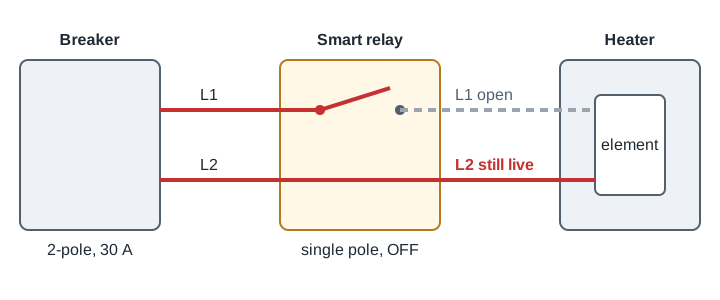
That is fine for what a smart switch is for, which is stopping the heating. It is not fine for working on the heater, and the code does not let a smart relay stand in for the disconnect. Section 422.31(B), as EC&M quotes the 2020 code, lets "a switch or circuit breaker located within sight of the appliance, or is lockable with provisions for locking to remain in place whether the lock is installed or not" serve as an appliance's disconnecting means.
Aeotec, whose documents do not say single or double pole, is just as clear that its switch is not the disconnect. The Gen5 instruction sheet read here says it "must wired behind an air break switch," and before wiring: "If the air break switch is out of sight, please lock it to 'OFF' position and tag it." That sheet is the ZW078-B/C edition. The US ZW078-A specifications are on Aeotec's support page.
The same pattern runs through line-voltage thermostats: Mysa switches one line on a 240 V baseboard, as the baseboard thermostat comparison explains, and the disconnect stays where it was.
Leviton's smart breaker is the exception in kind, not degree. It is the breaker, it is 2-pole, and it switches both lines. It also replaces the breaker in a Leviton Load Center and needs Leviton's LWHEM energy monitor to work, so it is a panel decision, not a water heater accessory. Its rating is chosen for the circuit, and only the 40 A part was read for this page.
What a schedule costs you in hot water#
A smart switch saves energy by keeping the elements off when nobody needs hot water. The catch is reheating time. Rheem gives its recovery formula on the specification sheet: gallons per hour equals watts divided by 2.42 times the temperature rise in °F. A 4,500 W element raising water 90 °F recovers 21 gallons an hour.
Rheem's 40-gallon Performance models are rated at 36 gallons. Heating all of it through a 90 °F rise at 21 gallons an hour takes about an hour and three quarters, so a schedule that switches the heater on at 6:00 for a 6:30 shower delivers part of a tank, not a full one.
Longer off periods add a second limit. Sinopé's RM3510WF guide says: "If your water heater has been off for several days, wait until the water temperature reaches 55 °C (131 °F) for at least 4 hours. Then, let the hot water run for a few minutes before using it." Its product page says the included temperature probe keeps a minimum temperature threshold to prevent bacterial growth. A plain relay has no such probe.
Radio, hub and what happens offline#
The radio decides what the switch talks to.
- Aeotec Heavy Duty Gen5 is Z-Wave, so it needs a Z-Wave controller such as Hubitat or SmartThings. Mesh behavior is in Z-Wave and Z-Wave Long Range. It reports watts and kWh to the controller, with a 2 W minimum reading.
- Sinopé RM3500ZB is Zigbee 3.0 and needs a gateway: Sinopé's GT130, or SmartThings or Hubitat, as its product page lists. Zigbee explained covers coordinators and range.
- Sinopé RM3510WF is 2.4 GHz Wi-Fi, which is the band Wi-Fi 2.4 GHz pairing problems is about. Sinopé lists native Google Assistant, Alexa and Apple Home integration, and "permanent internet connection" among its requirements.
Matter is not an option yet. The specification has had a water heater device type since Matter 1.4, and as Matter for energy records, no water heater was certified as of September 2026. Solar, batteries and EV charging covers the same gap across the rest of home energy.
None of the documents read says what the switch does when the internet or the hub is down, or which state the relay returns to after a power cut, except Insteon's choice of a normally open or normally closed relay. If a schedule must survive an outage, the questions to ask are in what still works in an internet outage.
Why not a plug, and what else to pair it with#
A 240 V water heater is hard-wired, so a plug-in smart plug is not an option, and the 120 V plug ratings in smart plugs and energy monitoring do not carry over. Those plugs top out at 15 A on 120 V, and the space heater comparison shows how quickly a 1,500 W heater uses that up.
A switch only manages the heating. A leak sensor in the drain pan, covered in leak and water sensors, watches for the other way a tank fails. Sinopé's controllers take an optional water detection cable that cuts power to the tank when it detects water, which puts both jobs in one box.
Where this page stops#
- Resistance tank heaters on 240 V. Tankless electric heaters are not covered. Heat pump water heaters have their own controls, and none of the documents read says how they respond to a relay cutting power, so this page makes no claim about them.
- The ratings in the documents read, as of October 2026. Intermatic's water heater time switches and Copeland's 75A01-100 water heater switch were not read from a first-party document this run, so they are not in the table. Neither are Enbrighten or Jasco heavy-duty relays.
- The code text is EC&M's quotation, not the code book. EC&M's quiz notes that the 2026 NEC classifies fixed storage water heaters of 120 gallons or less as continuous loads. Your jurisdiction may have adopted another edition or local amendments.
- Sinopé prices are in Canadian dollars, from its own site. No US price was published on the pages read.
- Renters: a hard-wired relay on the water heater is a landlord's decision; a smart home for renters covers what you can do without touching wiring.
What size smart switch do I need for a 4,500 W water heater?
One rated for at least 18.75 A resistive at 240 V, which is what a 4,500 W element draws. Sinopé's Calypso controllers are rated 20.8 A and Aeotec's Heavy Duty Smart Switch 40 A. The 30 A figure is the circuit breaker, which the code sizes at no less than 125% of the heater, 23.4 A.
Does a water heater smart switch have to be rated 30 amps?
Not according to the makers. Sinopé builds its controller for water heaters and rates it at 20.8 A, enough for up to about 5,000 W at 240 V. The 125% rule in NEC 422.13 applies to the branch circuit's overcurrent device and conductors, which is where 30 A comes from.
Can a smart switch be the disconnect for my water heater?
Not the ones read here. Sinopé's controllers switch one line, so the heater stays connected to the other. Aeotec says its switch must be wired behind an air break switch, locked off and tagged if it is out of sight. NEC 422.31(B) asks for a switch or breaker within sight of the heater or lockable.
Can I use a 120 V smart plug on an electric water heater?
No. A standard US electric tank heater is hard-wired to a 240 V circuit, with no plug to put a smart plug on. You need a hard-wired 240 V relay rated for the heater's current, such as Aeotec's Heavy Duty Smart Switch or Sinopé's Calypso controller.
Primary sources
Specification and vendor documentation we checked while writing this page. Where a claim depends on firmware behaviour rather than a published spec, the page says so inline.
- Aeotec, Heavy Duty Smart Switch Gen5 technical specifications
- Aeotec, Heavy Duty Smart Switch Gen5 instruction sheet (ZW078-B/C edition, eedomus copy)
- Sinopé, Calypso Smart Water Heater Controller RM3500ZB product fact sheet 270-2151-0001-B
- Sinopé, Calypso Zigbee water heater controller product page
- Sinopé, Calypso Smart Water Heater Controller V2 RM3510WF installation guide 660-0339-0001 (29 January 2026)
- Sinopé, Calypso V2 Wi-Fi water heater controller product page
- Insteon, 240V Load Controller 2477SA1 and 2477SA2 support page
- Leviton, 40A 2-Pole 2nd Gen Smart Branch Circuit Breaker LB240-ST
- Rheem, Performance electric water heaters specification sheet THD-PE06 N Rev. 6 (08/20)
- A.O. Smith, Hybrid Electric Heat Pump Water Heater installation instructions 100379656 (May 2024, Lowe's copy)
- EC&M, Code Quiz, Fixed Storage Type Water Heaters (NEC 422.13)
- EC&M, Code Q&A, Appliance Disconnecting Means (NEC 422.31, 2020 edition)