Can a smart thermostat run a millivolt gas fireplace or wall heater?
Not on the millivolt circuit alone. Every working route adds a 24 V transformer at the appliance, either inside a switching relay or as a separate part, and the thermostat runs on that while a relay contact or its own output closes the fireplace's millivolt loop.
Two answers circulate, and each is half right#
The first answer says it cannot be done. Google's Nest compatibility page lists millivolt systems as incompatible because they "use much less electricity than low voltage systems and can't deliver the right amount of power to Nest thermostats." ecobee's kit and Honeywell's T9 guide draw the same line, as smart thermostats without a C wire sets out. That is true of the thermostat wired the normal way: a fireplace's thermopile works in millivolts, and a thermostat with a screen and a Wi-Fi radio needs a steady 24 V.
The second answer says buy a thermostat that lists millivolt. The Lux TQ1's spec sheet does say "Additional compatibility: Millivolt heating", but the same sheet gives its power source as "19-30 VAC @50/60Hz, 40 VA, Class 2 or SELV" and its power as "C-wire or LUX Power Bridge." Listing millivolt is a claim about what it controls, not about what powers it.
The right answer sits between them: a smart thermostat can control a millivolt fireplace, and no route read here does it without bringing 24 V to the appliance.
Why a millivolt fireplace has nothing to power a thermostat#
A standing-pilot fireplace or wall heater makes its own electricity. A thermopile sits in the pilot flame and generates the small voltage that holds the gas valve open when the wall switch or thermostat closes the loop between two valve terminals, usually marked TH and TH/TP. Heat & Glo's SL-550TV-D manual says plainly that its "standing pilot ignition system wiring does not require a 110 VAC supply to operate."
That is why the fireplace works in a power cut, and why a Wi-Fi thermostat cannot live on it. HVAC School's floor for a thermopile under load is 190 mV. A wall switch is just a contact and needs none of it; a Wi-Fi thermostat needs current all the time, "120mA at 24VAC" (about 2.9 VA) in the Lux TQ1's case.
The isolation relay method#
HVAC School's method keeps the two circuits apart. "You'll be using an isolation relay. It's just an SPST (single-pole, single-throw) NO (normally open) relay," fed from a 120 V to 24 V transformer:
- "Wire the hot side of the 24v transformer to R on the Wi-Fi thermostat."
- "Connect W on the thermostat to one side of the relay coil. On the other side of the coil, you'll add C from the thermostat and common wire of the transformer."
- Move the old wires: "take the thermostat wires off your old millivolt thermostat and add them to the NO terminals on the relay."
On a call for heat the coil closes the contact, and the valve sees what it saw when the old wall switch closed. The thermopile never powers the thermostat.
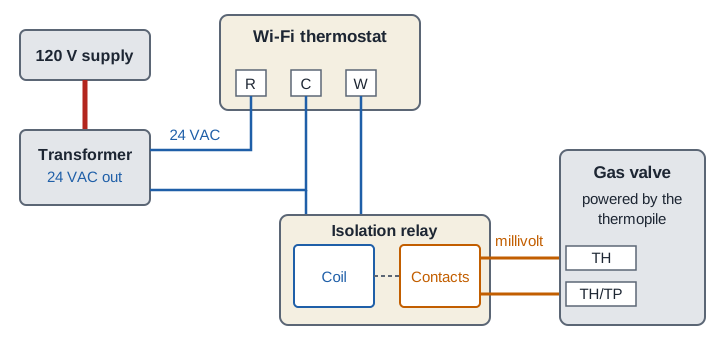
It is the same shape as a sprinkler controller's pump start relay, except that here the switched circuit is smaller than the control circuit rather than larger.
Honeywell's R8845U: the relay kit in one box#
Honeywell describes the R8845U Universal Switching Relay as "typically applied in hydronic heating systems", but it carries every part of the method. Its product data and installation instructions give:
| R8845U specification | As Honeywell states it |
|---|---|
| Supply | 120 Vac, 60 Hz |
| Internal transformer | 120 V primary, 24 Vac secondary, "12 VA maximum, 9 VA available for external loads", protected by a 1 A automotive fuse |
| Switching action | "Two Spst, plus Powerpile® rated low-voltage Spst" |
| Low-voltage contact terminals | X1 and X2, marked "LOW VOLTAGE POWERPILE® CONTROLLED OUTPUT" |
| Thermostat terminals | R(T), W(T) and C, with C "FOR SERIES 10 OR OTHER HARDWIRED ELECTRONIC 3-WIRE THERMOSTATS" |
| Ambient rating | -20°F to 120°F |
| Mounting | Three 1/2 in. knockouts in the case bottom for a conduit box |
| Price, October 2026 | $106.44 at Jackson Systems, $111.35 at PartsSource |
The C terminal is what makes it work for a Wi-Fi thermostat: wired to R, W and C, the thermostat sees a heat-only 24 V system. X1 and X2 take the old wall switch wires from the valve's TH and TH/TP circuit, and the two line-voltage relays stay unused. The power budget fits, too: the Lux TQ1's 2.9 VA against the R8845U's 9 VA available. Check any other thermostat's published draw against the same 9 VA.
The parts, side by side#
Prices as listed by US distributors and Lux in October 2026.
| Route | Parts | Parts cost | Where the 24 V comes from | Contact on the millivolt loop | Documented by |
|---|---|---|---|---|---|
| Honeywell relay kit | R8845U1003 plus any 24 V smart thermostat that takes a C wire | $106.44 plus the thermostat; $186.43 with a Lux TQ1 | Internal transformer, 9 VA for external loads | X1 and X2, Powerpile rated | Honeywell product data and installation instructions |
| Transformer plus relay | Functional Devices TR40VA002 (120 V to 24 V, 40 VA) and RIBU1C pilot relay, plus thermostat | $29.12 plus $18.75, so $47.87; $127.86 with a Lux TQ1 | The 40 VA transformer | The RIBU1C's normally open contact; no millivolt rating in the listing read | HVAC School method |
| Millivolt-listed thermostat | Lux TQ1 plus a 24 V transformer such as the TR40VA002 | $79.99 plus $29.12, so $109.11 | The transformer, on C | The thermostat's own output, rated 1.0 A resistive | Lux lists millivolt; its manual shows no millivolt wiring |
| Battery remote receiver (not Wi-Fi) | A receiver such as Skytech's 1001TH-A on TH and TH/TP | Not priced here | Four AA batteries in the receiver | The receiver | Skytech instructions |
What the table settles:
- Every Wi-Fi route has a transformer in it. Only the battery remote does without, and it is not a Wi-Fi thermostat.
- The R8845U costs about twice the two-part route, and buys a contact Honeywell rates for Powerpile use, a fuse, a test button and LEDs in one UL-listed box. The general relay's listing states a 10 A contact rating and nothing about millivolt circuits. That Honeywell rates its Powerpile contact separately from its line-voltage ones says switching millivolts is its own rating.
- The Lux Power Bridge does not help. It needs "both Y (cooling) and G (fan) wires", and a fireplace's two-wire loop has neither. The $22.99 bridge is a C-wire adapter for furnaces with air conditioning, like the ones in the C-wire comparison.
What the Lux TQ1 actually documents#
The TQ1 is the one Wi-Fi thermostat read here that lists millivolt at all. Beside "Millivolt heating", its spec sheet gives "Output Rating: 1.0A resistive load per terminal", and the product page says it "Requires constant power from a C-wire."
The installation manual is narrower. It says "This thermostat is for most 24VAC systems," and every wiring chart in it draws a 24 VAC transformer; none shows a millivolt valve. So a TQ1 on a fireplace still needs a transformer at the appliance, and the manual does not show how to land the millivolt loop on its terminals. Ask Lux for that diagram; without it, the TQ1 works on the relay routes above like any other 24 V thermostat.
The TQ1 is $79.99 on Lux's store (from $94.99), is Matter 1.4 certified over 2.4 GHz Wi-Fi, and keeps a "Locally stored 7 day heat and cool schedule." Matter gives it the thermostat device type described in Matter device types, so it pairs to Apple Home, Google Home, Alexa, SmartThings or Home Assistant without a Lux app.
Where the relay goes, and where its 120 V comes from#
The relay and transformer need 120 V near the fireplace, which a millivolt appliance does not otherwise need. Some have it anyway: Heat & Glo's manual calls for 110-120 VAC at the junction box for optional accessories. Where there is none, a circuit has to be run, and even for a battery remote Skytech says "A qualified electrician should install the remote control system."
Keep the millivolt leg short. Skytech limits the wires to the valve to "at least 18 Gauge (AWG)", "no longer than 20-feet" and "no splices", and Heat & Glo asks for "low resistance thermostat wire." A relay near the valve keeps that leg inside those limits, and the run to the wall becomes ordinary 24 V thermostat wire, the same class as a video doorbell transformer circuit.
What changes once the thermostat is smart#
- Power cuts. The thermostat and coil now depend on the transformer, so a power cut stops the calls for heat that the old wall switch would still have made.
- Internet outages are a separate question. The TQ1 stores its schedule on the device; the rest is in what still works in an internet outage and local versus cloud control.
- Wi-Fi. The TQ1 is 2.4 GHz only, the band 2.4 GHz pairing problems are about.
- Safety timers. Skytech's receiver shuts the appliance off if it hears nothing from its transmitter for 2 hours. A Wi-Fi thermostat on a relay has no such timer, one more reason a gas appliance belongs near a smoke and CO alarm.
Where this page stops#
- Read here: the sources listed below, as of October 2026. ecobee's compatibility checker did not load, and Napoleon and Empire manuals were not read, so the page makes no claim about their wording.
- Not stated in what was read: whether Nest or ecobee support their thermostats behind an isolation relay, and Lux's millivolt wiring for the TQ1.
- Prices are single distributor listings on the day read, before shipping and tax.
- Electronic ignition (IPI) fireplaces are not millivolt systems and are out of scope.
- Line voltage and gas work. The 120 V side is electrician work in many places, and the fireplace maker's manual decides what may connect to its valve. Renters should read a smart home for renters first. Electric baseboard heat is a different problem, covered in smart thermostats for baseboard heaters; the wider wiring picture is in smart thermostats and the C wire.
Can I use a Nest or ecobee on a millivolt gas fireplace?
Not wired directly. Google says millivolt systems "can't deliver the right amount of power to Nest thermostats", and ecobee's and Honeywell's documents exclude millivolt too. With an isolation relay and a 24 V transformer, such as Honeywell's R8845U, the thermostat runs on 24 V and the relay contact closes the fireplace's millivolt loop.
Is there a Wi-Fi thermostat made for millivolt systems?
The Lux TQ1 lists "Millivolt heating" on its spec sheet, but it still needs 19 to 30 V AC from a C wire. A fireplace has no 24 V supply, so you still add a transformer, and Lux's manual shows no millivolt wiring diagram.
What relay do I need to connect a smart thermostat to a millivolt valve?
An SPST normally open relay with a 24 V coil, fed by a 120 V to 24 V transformer, per HVAC School. Honeywell's R8845U combines both, with a Powerpile-rated contact on X1 and X2 and a C terminal for the thermostat, for about $106 to $111 in October 2026.
Will my fireplace still work in a power outage with a smart thermostat?
Not from the thermostat. The valve still runs on its thermopile, but the thermostat and relay coil need the transformer's 24 V, so no call for heat reaches the valve while the power is off.
Primary sources
Specification and vendor documentation we checked while writing this page. Where a claim depends on firmware behaviour rather than a published spec, the page says so inline.
- Lux Products, TQ1 Smart Thermostat spec sheet TQ1-BL-L04 (June 2025, SupplyHouse copy)
- Lux Products, TQ1 Matter Smart Thermostat product page
- Lux Products, TQ1 Smart Thermostat installation and instruction manual v03
- Resideo (Honeywell), R8845U Universal Switching Relay product data 68-0215-03
- Resideo (Honeywell), R8845U Universal Switching Relay installation instructions 69-1292-05
- PexUniverse, Honeywell R8845U1003 Universal Switching Relay listing
- Jackson Systems, Honeywell R8845U1003 Universal Switching Relay listing
- PartsSource, Honeywell R8845U1003 listing
- Jackson Systems, Functional Devices TR40VA002 transformer listing
- Building Controls, Functional Devices RIBU1C pilot relay listing
- HVAC School, Millivolt systems with modern thermostats (December 2019)
- Google Nest Help, Nest thermostat compatibility
- Heat & Glo, SL-550/750/950TV-D owner's manual 2053-985 Rev. J (ManualsLib copy)
- Skytech, 1001TH-A remote control installation and operating instructions (retailer-hosted copy)