How much do smart dimmers derate when ganged in one box?
For filament bulbs, about 100 W per step, and Lutron counts the step by where the dimmer sits, not how big the box is. For LED, not at all on any smart dimmer read for this page. The LED number people quote as derated comes from Lutron's non-smart Pro dimmer and from Caseta's on/off switch.
Two answers circulate, and the bulb type settles it#
The first answer says that every dimmer loses capacity when you put two or three in one box, so a 150 W LED dimmer becomes something like a 100 W one. The second says ganging only matters for old filament bulbs, and LED loads can ignore it.
For the smart dimmers on this page, the second answer is right, and it is right because the documents say so in plain numbers. Lutron's Caseta specification submittal lists the PD-6WCL at 150 W LED "Not Ganged", 150 W at "End of Gang" and 150 W at "Middle of Gang". Leviton's D2ELV and DN6HD sheets say "No reduction is necessary if the load is LED or CFL." Inovelli and Jasco state their reduction for incandescent only and give one LED figure.
The first answer persists because it is true of other Lutron products, and both are easy to mistake for a smart dimmer:
- Lutron's non-smart Diva LED+ Pro, DV-PRO, derates LED to 250 W not ganged, 200 W at the end of a gang and 150 W in the middle. If you have seen 250, 200, 150 quoted for "Lutron dimmers", this is the pattern.
- Caseta's own on/off switch, PD-5WS-DV, derates LED from 5 A to 4 A to 3 A., in the same table as the dimmers.
So the bulb decides. On LED, box size does not change the rating of any smart dimmer read here. On incandescent or halogen it does, by the figures below.
Why a dimmer loses capacity next to another one#
A dimmer turns a little of the power it controls into heat, and its metal side sections are there to shed it. Leviton says so outright on its Renoir dimmer sheet: those dimmers "have anodized aluminum fins that dissipate heat generated by proper functioning of the dimmers." Put two in one box and you have to snap off the fins between them to make them fit, and they share the same air. The derating is the maker's allowance for that.
Two details follow from the reason. First, Lutron's Diva Smart dimmers ship with no fins at all, and its advanced installation guide still says: "Diva Smart controls don't have fins but derating is still required." No fins to break off does not mean no derating. Second, the Leviton Renoir sheet adds a rule worth keeping for any dimmer: "DO NOT GANG DIMMERS VERTICALLY (ONE DIRECTLY ABOVE ANOTHER)."
The ratings, model by model#
As each maker publishes them, read in October 2026, for 120 V models. "End of gang" is a dimmer with a neighbor on one side, which is both dimmers in a two-gang box. "Middle of gang" has neighbors on both sides, which is the center dimmer in a three-gang box. Where a maker states its figures by box size instead, they are placed in the matching column.
| Model | Type | LED, not ganged | LED, ganged | Incandescent / halogen: not ganged | End of gang (2-gang) | Middle of gang (3-gang) |
|---|---|---|---|---|---|---|
| Lutron Caseta PD-6WCL | No-neutral dimmer | 150 W | 150 W, end and middle | 600 W | 500 W | 400 W |
| Lutron Diva Smart DVRF-6L | No-neutral dimmer | 150 W | 150 W, end and middle | 600 W | 500 W | 400 W |
| Lutron Caseta PRO PD-10NXD | Neutral-optional dimmer | 250 W | 250 W, end and middle | 1000 W | 800 W | 600 W |
| Lutron Caseta ELV+ PD-5NE | Neutral dimmer | 250 W | 250 W, end and middle | 500 W (ELV halogen the same) | 400 W | 300 W |
| Leviton Decora Smart D2ELV | Neutral dimmer | 300 W | "No reduction" | 600 W (ELV 600 VA) | 500 W (ELV 500 W) | 500 W (ELV 500 W) |
| Leviton Decora Smart DN6HD | No-neutral dimmer | 300 W | "No reduction" | 600 W (MLV 600 VA) | 500 W (MLV 500 VA) | 500 W (MLV 500 VA) |
| Leviton Decora Smart D26HD | Neutral dimmer | 300 W | Not stated | 600 W | Not stated | Not stated |
| Inovelli Blue Series VZM31-SN | Neutral or no-neutral dimmer | 300 W | No gang figure given | 600 W | 500 W | 400 W |
| Enbrighten Z-Wave 46203 (ZW3010) | Neutral dimmer | 300 W | No gang figure given | 600 W | 500 W | 400 W |
| Jasco Z-Wave 39351 (ZW3005) | Neutral dimmer | 150 W | No gang figure given | 600 W | 500 W | 400 W |
Sources: Lutron spec submittal 369987 and the PD-6WCL quick install guide, Leviton's D2ELV, DN6HD and D26HD documents, Inovelli's VZM31-SN manual and Jasco's 39351 and 46203 manuals. Lutron's PD-5NE also keeps its magnetic low-voltage rating at 400 VA in every position, and its PD-10NXD drops MLV halogen from 1000 VA to 800 VA to 600 VA, the same steps as incandescent. Lutron's plug-in lamp dimmer, PD-3PCL, is marked "Cannot be ganged", which is moot for a lamp module.
The D26HD row is a gap, not a pass: its specification sheet has no ganging line at all. Leviton's other two Decora Smart dimmer sheets both apply the 500 W rule, so plan on that until the D26HD's own instruction sheet says otherwise.
Three things come out of the table that no single document states:
- The step is almost always 100 W. Every 600 W smart dimmer that publishes a ganging rule loses 100 W for its first neighbor, and so does the 500 W PD-5NE. Lutron's PRO model is the exception at 200 W a step, from a 1000 W start.
- LED is never the figure that moves. Across the nine dimmers from four makers that publish a ganging rule, no ganged LED rating is lower than the single one. Where a maker gives only one LED figure, it gives that one figure next to a gang-specific incandescent list.
- Leviton is the most generous in a three-gang box. Its rule is one number for any dimmer "installed next to" another, so the center dimmer keeps 500 W where Lutron, Inovelli and Jasco give it 400 W.
Position in the gang, not the size of the box#
Lutron writes its ratings by position, and that changes the answer in boxes of three or more. Its specification submittal labels the columns "Not Ganged", "End of Gang" and "Middle of Gang". Its PD-6WCL quick install guide labels the same values by side sections removed: none, one side, two sides, at 600 W, 500 W and 400 W. And it says "Do not remove outside side sections on dimmers at the end of gang."
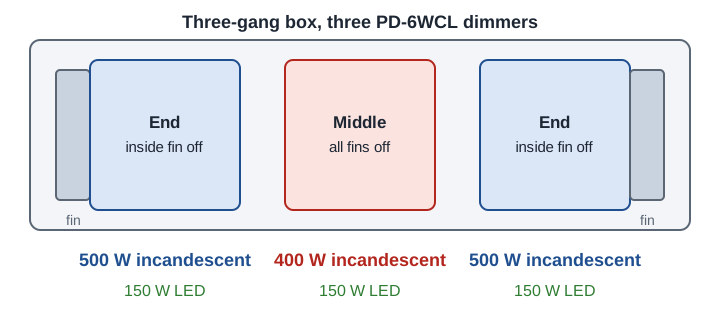
So in a three-gang box of Caseta dimmers, a heavy halogen load belongs on an end dimmer.
Jasco and Inovelli state theirs by box size instead: "1-gang 600W, 2-gang 500W or 3-gang 400W" in Jasco's words, "600W Single-Gang, 500W Double-Gang, 400W Triple-Gang" in Inovelli's. Neither separates the end from the middle, so read the three-gang figure as the rating for every dimmer in that box.
Lutron's wording also counts any neighbor, not just another dimmer: "When ganging with other switches / dimmers in the same wallbox, derating is required." By that wording, a Caseta dimmer beside a plain toggle takes the end-of-gang rating. Leviton's sentence names dimmers only, "When two or more dimmers are installed next to each other."
Mixing LED and filament bulbs on a ganged dimmer#
LED watts do not count one for one against an incandescent allowance. Lutron's advanced installation guide gives the PD-6WCL a mixing chart that starts at 0 W of LED plus 600 W of incandescent and steps down to 126 W to 150 W of LED plus 0 W. Every 25 W band of LED takes 100 W off the filament allowance.
That chart starts at the 600 W rating for a dimmer that is not ganged. For a ganged Caseta dimmer on mixed bulbs, Lutron's quick install guide sends you to www.casetawireless.com/ganging rather than printing the figures.
The simplest fix is not to mix bulb types on a ganged dimmer at all.
A worked example: a three-gang box by the kitchen door#
Three Caseta PD-6WCL dimmers in one box, controlling recessed lights, pendants and a halogen track.
- Recessed lights, eight 9 W LED downlights, 72 W. Under 150 W at any position. Ganging changes nothing.
- Pendants, three 60 W incandescent globes, 180 W. Under 400 W, so fine even in the middle.
- A track of nine 50 W halogen lamps, 450 W. Over the 400 W middle rating, under the 500 W end rating. Put this dimmer at an end, or move the track to a PD-10NXD, which carries 600 W even in the middle.
The same box built from Leviton DN6HD dimmers gives every position 500 W, and the track fits anywhere. Built from Inovelli VZM31-SN dimmers, every position gets 400 W, and the track does not fit at all on incandescent.
What derating does not cover#
The derated watts are the maker's rating for heat. Three other tests decide whether the gang works, and all of them get harder as the box gets wider.
Box fill and depth. Each dimmer's yoke counts two conductor allowances in the code's box fill count, and multi-gang boxes collect more cables. Will a smart switch fit in your box has the minimum depths by brand and the worked fill counts, including a two-gang example. A shallow product helps with depth: Leviton gives the D26HD a product depth of 1.3 in.
Radio range. Leviton's D2ELV sheet warns that "Installation in metal wall boxes or with metal wall plates may result in poor RF performance." If your multi-gang box is steel, that matters for Wi-Fi dimmers, as the hidden costs of Wi-Fi smart devices explains, and for a mesh that leans on wall switches to relay, as covered in Z-Wave and Z-Wave Long Range and Zigbee. Lutron's Clear Connect radio is covered in proprietary radios.
Neutral and minimum load. Ganging does not change a no-neutral dimmer's minimum, but three no-neutral dimmers in one box are three separate trickle currents through three loads. The minimum load for a no-neutral smart switch has each maker's figure.
Where these numbers stop applying#
- The models named, at 120 V. Lutron publishes different 277 V figures for some Caseta switches. A different model in the same family can have a different table, as the PD-5NE and PD-6WCL show.
- Switches are not dimmers. Caseta's PD-5WS-DV switch derates LED, as above. The PD-6ANS keeps 6 A of LED at an end and drops to 5 A in the middle. The PD-5ANS and Claro DVRF-5NS keep 5 A at every position. The table above is for dimmers.
- Fan controls and motors. A dimmer on a fan is wrong at any gang count; smart dimmers on ceiling fans explains why.
- Aluminum wiring. It changes the job before ganging does. Leviton's D2ELV sheet says "Not for use with aluminum wire", and smart switches on aluminum wiring has each maker's wording and the repair.
- Revisions. These are the figures in the documents as read in October 2026. The instruction sheet in the box is the one your inspector reads.
For the broader buying checks, smart switches, dimmers and the neutral wire covers 3-way wiring and gang width, the pre-purchase checklist puts the box next to the neutral and radio checks, and smart lighting that stays compatible covers the choice between a smart dimmer and smart bulbs when the box is full. Check the platform in the compatibility checker before you buy three of anything.
Can I put two smart dimmers in one box?
Yes, every maker read for this page allows it, with a reduced incandescent rating. Two Lutron Caseta PD-6WCL dimmers are each rated 500 W incandescent instead of 600 W, and two Leviton Decora Smart DN6HD or D2ELV dimmers 500 W each. The LED rating does not change: 150 W for the PD-6WCL, 300 W for Leviton.
Do I need to derate a smart dimmer for LED bulbs?
Not for the smart dimmers read here. Lutron lists the same LED rating not ganged, at the end and in the middle of a gang. Leviton says no reduction is necessary for LED or CFL. The LED derating people quote, 250 W to 200 W to 150 W, is from Lutron's non-smart Diva LED+ Pro, DV-PRO.
Does a dimmer in the middle of a three-gang box derate more?
On Lutron, yes. Its tables rate the center dimmer of three, with all fins removed, lowest: 400 W incandescent for a PD-6WCL against 500 W at each end. Jasco and Inovelli give one figure per box size, 400 W in a three-gang box. Leviton gives 500 W to any dimmer next to another.
Do Lutron Diva Smart dimmers need derating if they have no fins?
Yes. Lutron's installation guide says "Diva Smart controls don't have fins but derating is still required." The DVRF-6L carries the same figures as the Caseta PD-6WCL: 600 W, 500 W and 400 W incandescent by position, and 150 W LED at every position.
Primary sources
Specification and vendor documentation we checked while writing this page. Where a claim depends on firmware behaviour rather than a published spec, the page says so inline.
- Lutron, Caseta load controls specification submittal 369987 (rev. 2.24.23), distributor copy
- Lutron, Caseta Wireless In-Wall Dimmer PD-6WCL quick install guide, via ManualsLib
- Lutron, Caseta Wireless Advanced Installation Guide P/N 0301710 (rev. 11/2022), via ManualsLib
- Lutron, Caseta Wireless Advanced Installation Guide P/N 0301710 (rev. 06/2024), via ManualsLib
- Lutron, Diva LED+ Pro DV-PRO and DV-PS installation instructions P/N 041966 Rev D (09/2026)
- Leviton, Decora Smart Wi-Fi ELV/LED dimmer D2ELV getting started guide
- Leviton, Decora Smart No-Neutral Dimmer DN6HD instruction sheet
- Leviton, Decora Smart Wi-Fi 2nd Gen Dimmer D26HD specification sheet
- Leviton, Renoir dimmer 80800, 81000, 81500, 82000 instruction sheet
- Inovelli, Blue Series Dimmer Switch manual (VZM31-SN)
- Jasco, Z-Wave In-Wall Smart Dimmer 39351 (ZW3005) manual
- Jasco, Enbrighten Z-Wave In-Wall Smart Dimmer 46203 (ZW3010) manual, via Lowe's