Will a smart lock fit my door, and how thick can the door be?
On a standard US exterior door, 1 3/4 in thick with a 2 1/8 in hole, almost certainly yes. Thickness is the test that splits brands, and an existing hole that is too big is the one fault no kit fixes.
Two answers circulate, and the gap between them is thickness#
Ask whether a smart lock will fit and you get two answers. Makers say their locks fit standard doors: U-tec says the Ultraloq U-Bolt Pro "is designed to fit any US standard door". Installers say measure first, because plenty of doors are not standard. Both are right, and they are talking about different measurements.
Of the four measurements that decide fit, three are close to universal on US residential doors, and every lock read for this page accepts the same values for them. The fourth, door thickness, is where the published ranges diverge, by as much as half an inch. So "fits any standard door" is true when "standard" means 1 3/4 in, the thickness every lock here accepts. It stops being true on a thin interior-grade door, a thick custom door, or a door where somebody has already enlarged the hole.
Yale's own installation guide labels its 1 3/8 to 1 3/4 in screw set "Standard", which is a fair working definition. Outside that range, check the table before you buy.
The four measurements, and where each one is taken#
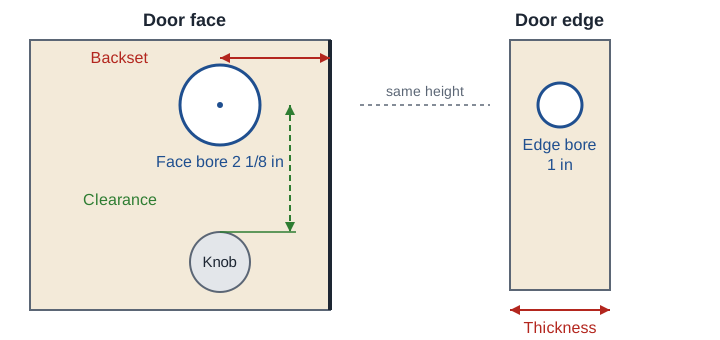
- Face bore (also called cross bore): the large hole through the face of the door. 2 1/8 in on every lock here.
- Edge bore: the hole from the door edge into the face bore, for the bolt. 1 in wherever it is published.
- Backset: from the door edge to the center of the face bore. 2 3/8 in (60 mm) or 2 3/4 in (70 mm), and every lock here has a latch that adjusts to either.
- Door thickness: across the edge of the door. This is the one that varies.
The table: what each maker publishes#
These are the figures in each maker's own documents, as of October 2026. A blank means the documents read for this page give no figure, not that the lock has no limit.
| Lock | Door thickness | Face bore | Edge bore | Backset | Kit for thicker or thinner doors |
|---|---|---|---|---|---|
| Schlage Encode (BE489) | 1 3/8 to 1 3/4 in | 2 1/8 in | 1 in | 2 3/8 or 2 3/4 in | Thick door kit, 1 7/8 to 2 1/4 in, from Schlage product support |
| Yale Assure Lock 2 (YRD410, YRD420, YRD430, YRD450) | 1 3/8 to 2 1/4 in | 2 1/8 or 1 1/2 in | 1 in | 2 3/8 or 2 3/4 in | None needed: three screw sets in the box |
| Yale Assure Lock, first generation (YRD216, YRD226, YRD256) | 1 3/4 or 2 1/4 in | 2 1/8 in | 1 in | 2 3/8 or 2 3/4 in | 1 3/8 in "requires special order thin door kit" |
| Kwikset Halo | 1 3/8 to 2 in, "automatic adjustment" | 2 1/8 in | 1 in | 2 3/8 or 2 3/4 in | Not in the sheet read |
| August Wi-Fi Smart Lock, bundled Yale deadbolt (4881) | 1 3/8 to 1 3/4 in | 2 1/8 in | 1 in | 2 3/8 or 2 3/4 in | Not in the page read |
| eufy smart locks | 1 3/8 to 2 1/8 in (35 to 55 mm) | 2 1/8 to 1 1/2 in | 1 in | 2 3/8 or 2 3/4 in | Not in the page read |
| Ultraloq U-Bolt Pro series | 1.375 to 1.75 in (35 to 45 mm) | 2 1/8 in | 1 in | 2 3/8 or 2 3/4 in | Ultraloq Thick Door Kit, 1 3/4 to 2 1/4 in |
| Level Bolt and Level Lock Touch Edition | 1 3/4 in | 2 1/8 in | 2 3/8 or 2 3/4 in | Not in the pages read |
Two notes on reading it. Schlage's thick door kit figure is from its Encode preparation sheet, which says the kit fits the Encode to doors 1 7/8 to 2 1/4 in thick and is "available from Product Support"; the retail Schlage kit for the Connect, Sense and Touch deadbolts (part 23997877) carries the same 1 7/8 to 2 1/4 in range. And Ring's store lists Level's requirement as a "Door Width of 1 3/4"", which in context is the door's thickness.
Your door against every lock#
Turn the table around and the answer for your door falls out. "Kit" means the maker publishes a kit that covers that thickness.
| Door thickness | Fits out of the box | Fits with a kit | Does not fit, per the documents read |
|---|---|---|---|
| 1 3/8 in (thin, interior-grade) | Schlage Encode, Yale Assure Lock 2, Kwikset Halo, August bundled deadbolt, eufy, Ultraloq | Yale Assure first gen (special order) | Level |
| 1 3/4 in (standard exterior) | All eight | None | |
| 2 in | Yale Assure Lock 2, Kwikset Halo, eufy | Schlage Encode, Ultraloq | Level, August bundled deadbolt |
| 2 1/4 in | Yale Assure Lock 2, Yale Assure first gen | Schlage Encode, Ultraloq | Kwikset Halo (stops at 2 in), eufy (stops at 2 1/8 in), Level, August bundled deadbolt |
Yale's original Assure sheet lists the thickness as "1 3/4" or 2 1/4"", two values rather than a range, so this page puts it in neither column at 2 in. The Assure Lock 2 is the only lock here that covers the whole span from 1 3/8 to 2 1/4 in with parts in the box.
There is one quiet gap in Yale's own parts list. The Assure Lock 2 guide names three screw sets: blue Set B for a 1 3/8 in door, black Set C for 1 3/8 to 1 3/4 in, and silver Set D for 2 to 2 1/4 in. A door that measures between 1 3/4 and 2 in is not named by any set. The spec sheet's 1 3/8 to 2 1/4 in range covers it on paper, so ask Yale which set to use before you drill anything.
The rule both Schlage and Yale state: smaller holes can be fixed, bigger ones cannot#
This is the one measurement that ends the search rather than narrowing it.
Schlage's Encode preparation sheet: "If hole sizes are larger than those shown, then the lock will not fit properly on the door." If they are smaller, it tells you to enlarge them, with a 2 1/8 in hole saw for the face and a 1 in bit for the edge. Yale's "Check Your Door" guide makes the same split: a face bore or edge bore smaller than its template means "Adjust diameter", and a larger one means "Your door is not a match for a Yale smart lock". Yale adds that "there are some cases where existing holes cannot be adjusted to be compatible."
So an old door with a small 1 1/2 in bore is a drilling job, and two of the brands here, Yale's Assure Lock 2 and eufy, accept a 1 1/2 in face bore without drilling at all. A door where a previous lock needed a bigger hole is a door these locks do not fit. That usually means a replacement door, or a lock designed for a different preparation, which this page does not cover.
Backset works the same way, but with no drilling fix. Schlage: "If existing backset is not 2 3/8" or 2 3/4", then the lock will not fit properly on the door." Yale's checker gives the same two values.
Measure your door in five minutes#
Measure the thickness at the edge
Open the door and measure straight across the edge, near the lock. Use the bare door, not the weatherstrip or a decorative panel. Compare it with the second table above.
Measure the backset to the center
Measure from the door edge to the center of the face bore. If you only measure to the near edge of the hole, add half the hole's width. The answer should be 2 3/8 or 2 3/4 in.
Measure both holes
The face bore should be 2 1/8 in, or 1 1/2 in if you are looking at Yale's Assure Lock 2 or eufy. The edge bore should be 1 in. Larger than that rules the lock out.
Check the clearance to the knob
Yale asks for at least 2 in from the center of the deadbolt hole to the top of the knob or lever rose below it. A deadbolt set close above the handle can stop a wide interior housing from sitting flat.
Check the strike
Schlage's sheet has you hold the new strike and reinforcement plate against the jamb before installing, and chisel or drill if they do not seat. Yale's guide asks for a strike pocket 1 in across and 1 in deep.
Retrofit locks move the question to your deadbolt#
Two locks on this page do not replace the whole deadbolt. The August Wi-Fi Smart Lock mounts over the inside thumbturn of the deadbolt you already have, and Level sells Level Bolt as a way to retrofit your existing lock and "retain your matched home design and keys". For these, door thickness is mostly your existing deadbolt's problem. What matters is which deadbolt you have.
August says its locks are "only compatible with single cylinder deadbolts" and lists what does not work: mortise locks, double cylinder deadbolts (a keyhole on both sides), Medeco and Mul-T-Lock, and single sided deadbolts. Its compatibility list also excludes low-profile Kwikset and Weiser deadbolts, many newer low-profile Baldwin Estate locks, and Defiant deadbolts from 2015 on. The Wi-Fi Smart Lock itself is 2 7/8 in across and needs "a minimum clearance of 1 5/8 inches (41 mm) to either side of the center of the mounting hole", so a handle or a door frame close to the thumbturn can block it.
Level says Level Bolt is "designed to work with most American standard deadbolts" and ships three tailpiece adapters, but its door requirement is still a 1 3/4 in door with a 2 1/8 in bore.
A retrofit is also the easiest lock to take with you, which is why smart home for renters puts the interior-only kind first. If you are moving out, keep the original thumbturn so the door can go back the way you found it.
Choosing around the door you have#
Fit narrows the list; it does not pick the lock. Once you know which brands fit, the decisions in the smart locks guide take over: which platform manages codes, whether you want a keyway, and the battery type.
- Thin door, 1 3/8 in. Six of the eight fit as sold. Skip Level, and order Yale's thin door kit first if you want a first-generation Assure. If the door leads to a garage or porch, the inside half of the lock sits in that space, so check its inside temperature rating in the cold weather article too.
- Standard door, 1 3/4 in. Fit is not the constraint. Choose by connection: Matter over Thread needs a Thread border router, Z-Wave needs a hub with the Z-Wave radio, and the compatibility checker shows what your combination supports.
- Thick door, 2 in or more. Yale's Assure Lock 2 is the only lock here that covers the full range out of the box. Schlage and Ultraloq need their kits. Kwikset Halo reaches 2 in and eufy 2 1/8 in, but neither reaches 2 1/4 in.
A lock that fits the door is only as strong as the frame it locks into. The security section of the locks guide makes the case for a longer strike screw set into the stud, and the strike step above is the moment to do it; securing a smart home network covers the account and firmware side of the same risk. Fit also belongs on the pre-purchase checklist next to the platform questions, the same way box depth belongs next to the neutral wire in smart switch box depth and fill.
Where this page stops#
- The locks and documents named. Other models in the same family can differ, as Yale's two Assure generations do. Aqara, Lockly, Wyze and others were not read, so this page makes no claim about them.
- US bored deadbolts. Mortise locks, European profile cylinders and multipoint door hardware use different preparations, and none of the figures here apply to them.
- Holes that are already too big. Both Schlage and Yale say an oversized bore rules their locks out. This page does not cover repair plates or new door preparations.
- Your model's own guide wins. Check the guide in the box, and ask the maker about a kit before you drill. If a lock you rely on has gone quiet rather than failed to fit, start with a device that stops responding.
Will a smart lock fit my door?
Almost certainly, if your door is 1 3/4 in thick with a 2 1/8 in face bore, a 1 in edge bore and a backset of 2 3/8 or 2 3/4 in. Every lock from Schlage, Yale, Kwikset, August, eufy, Ultraloq and Level read for this page accepts those values. Thickness outside 1 3/8 to 1 3/4 in, or a hole larger than 2 1/8 in, is where fit fails.
What is the maximum door thickness for a smart lock?
It depends on the brand, and here are the limits. Yale's Assure Lock 2 goes to 2 1/4 in out of the box. Schlage's Encode reaches 2 1/4 in with a thick door kit and Ultraloq's U-Bolt Pro with its Thick Door Kit. Kwikset Halo stops at 2 in, eufy at 2 1/8 in, and Level and August's bundled deadbolt at 1 3/4 in.
Will a smart lock fit a 2 inch thick door?
Yale's Assure Lock 2, Kwikset Halo and eufy's locks fit a 2 in door without extra parts. Schlage Encode and Ultraloq U-Bolt Pro fit with their thick door kits. Level and the deadbolt bundled with the August Wi-Fi Smart Lock are rated only to 1 3/4 in.
What if my door's hole is bigger than 2 1/8 inches?
Then these locks do not fit it. Schlage says a lock will not fit properly if the holes are larger than specified, and Yale's door checker says the door is not a match. A hole that is too small can be enlarged with a 2 1/8 in hole saw, but a hole that is too big cannot be made smaller by drilling.
Primary sources
Specification and vendor documentation we checked while writing this page. Where a claim depends on firmware behaviour rather than a published spec, the page says so inline.
- Schlage, Encode BE489 door preparation instructions for a door with existing holes
- GoKeyless, Schlage 23997877 thick door kit for BE468, BE469 and BE479
- Yale, Assure Lock 2 specification sheet (YRD410, YRD420, YRD430, YRD450)
- Yale, Assure Lock 2 keyed deadbolt installation guide YRD410 and YRD420
- Yale, Assure Lock family specification sheet (YRD216, YRD226, YRD256)
- Kwikset, Halo Wi-Fi smart lock specification sheet
- August, product specifications for the deadbolt bundled with the Wi-Fi Smart Lock
- August, which deadbolts are compatible with August smart locks
- August, Wi-Fi Smart Lock FAQ
- eufy, compatibility and requirements for eufy smart locks
- U-tec, Ultraloq U-Bolt Pro series specifications
- Ring, Level Bolt door requirements
- Ring, Level Lock Touch Edition door requirements