Can a smart sprinkler controller run a well pump?
Yes, through a pump start relay and never directly. The part most guides skip is that the controller's pump terminal has a current limit, and one maker's relay can draw more than another maker's controller is rated to supply.
Two answers circulate, and the second one is the trap#
The first says a smart controller can switch the pump itself, the way a smart plug switches a lamp. It cannot. A sprinkler controller puts out 24 V AC to open valve solenoids, the same low-voltage class as a doorbell transformer or the thermostat wires on a furnace, and a well or lake pump runs on 120 or 240 V at currents far beyond that terminal. Rachio's wiring guide puts it bluntly: "The pump should never be wired directly to the controller; doing so will damage your Rachio controller, as well as void your warranty." Rain Bird's ESP-TM2 and ARC manuals both say the controller "DOES NOT provide power for a pump", and B-hyve's guide says "you must purchase a Pump Start Relay."
The second says any pump start relay works with any controller, because they all have a 24 V coil. The coil voltage does match, which is why the pairing looks safe. But a coil has a current draw, a pump terminal has a limit, and the makers publish the two numbers in different documents. Side by side, they do not always fit.
What a pump start relay does#
A pump start relay is a contactor in a weatherproof box. Its coil connects to the controller's pump terminal (marked M, MV, P or PUMP) and a common (C) terminal, and when the controller opens a zone, it energizes that terminal. The coil pulls in the relay's contacts, and those switch line-voltage power from the breaker to the pump. The controller only ever carries the coil current.
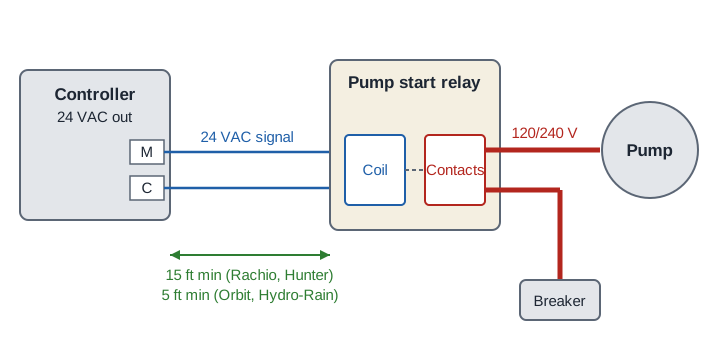
The same terminal also drives a master valve, the normally closed valve at the start of the main line that opens whenever any zone runs. Rachio's guide says a master valve should be wired only to M and C, and Hunter lists one master valve/pump output on the Pro-HC, so the relay and a master valve compete for the same terminal and the same current limit.
The pump terminal limits, side by side#
As each maker publishes them, read in October 2026. "Terminal" is the pump or master valve output; "controller total" is everything the transformer supplies at once.
| Controller | Pump terminal limit | Controller total | Zones | Wi-Fi | Source |
|---|---|---|---|---|---|
| Rachio 3 and 3 Pro | Relay plus valve "does not exceed 1.3 amps at 24 VAC" | Transformer 24 VAC, 850 mA | 4 to 16 | 2.4 or 5 GHz | Rachio wiring guide and tech specs |
| B-hyve 57950 (12 station) | 250 mA "each station/pump" | 500 mA load; 750 mA max load in the specs | 12 | 2.4 GHz | Orbit user's guide 57946-24 |
| B-hyve XR (57985, 57995) | Not stated | 24 VAC, 1 A max load | 8 or 16 | 2.4 and 5 GHz | XR manual, Orbit pages |
| Hunter Pro-HC (Hydrawise) | P/MV 0.28 A | Transformer 24 VAC, 1.0 A; station 0.56 A | Up to 24 | Built in | Hunter figures via Reinders |
| Rain Bird ESP-TM2 | Not stated separately | Output 1 A at 24 VAC | 4 to 12 | With the LNK WiFi module | Rain Bird tech spec |
| Rain Bird ARC8 | Not stated | Not stated | 8 | Built in | Rain Bird manual |
Prices on the makers' US stores in October 2026: B-hyve 57950 $164.69, B-hyve XR 8 station $169.99 and 16 station $199.99.
Two things in the table need a second look:
- Rachio's two numbers disagree. The wiring guide allows 1.3 A for relay plus valve. The tech specs give the transformer's output as 850 mA. A load can only draw what the transformer supplies, so the 850 mA is the figure to plan against, and the 1.3 A is best read as the terminal's own rating rather than a budget you can spend.
- B-hyve's guide carries two totals: "the maximum loading for the timer is 500mA" on the wiring page, 750 mA in the specifications. For a relay, the binding figure is the 250 mA per terminal. Orbit's 57950 and XR pages say each is "Capable of powering a pump start relay and one valve solenoid at the same time".
What the relays and valves draw#
The other half of the arithmetic is the load. Coil draw is published for one relay and three solenoids read here.
| Device | Inrush | Holding | Pump rating | Source |
|---|---|---|---|---|
| Rain Bird PSR110IC and PSR220IC relay | 950 mA | 360 mA | 120 V up to 2 hp, 240 V up to 5 hp; 40 A relay | Rain Bird PSR tech spec |
| Orbit 57009 relay ($54.99) | Not stated | Not stated | 120 VAC up to 1 HP, 240 VAC up to 2 HP; 25 A at 240 V | Orbit product page |
| Hydro-Rain relay | Not stated | Not stated | "as long as the current does not exceed 25 amps (about 2 Horsepower)" | Husqvarna Water knowledge base |
| Munro StartBox MPSR242W11 and W22 | Not read | Not read | 110 V up to 2 hp, 220 V up to 5 hp | Rachio wiring guide |
| Rain Bird G3/DV solenoid (DV, HV, ASVF, LFV valves) | 0.30 A | 0.19 A | Rain Bird D42606 | |
| Rain Bird G4 solenoid (PGA, PE, EFB, BPES valves) | 0.41 A | 0.14 A | Rain Bird D42606 | |
| Orbit inline valve (57101 family) | 0.30 A | 0.19 A | Orbit catalog sheet |
Holding current is the steady draw for as long as the zone runs; inrush lasts a moment at switch-on. The comparison below uses holding current, because it is the load the terminal carries for the whole run.
Which pairings fit, with the arithmetic#
Using the Rain Bird PSR, the one relay here with a published coil draw, plus one zone valve at the common 0.19 A holding figure:
| Controller | Relay alone (0.36 A) against the pump terminal | Relay plus one valve (0.55 A) against the controller total | Result |
|---|---|---|---|
| Rain Bird ESP-TM2 | No separate limit published | Under 1 A | Fits, and Rain Bird lists the PSR110IC and PSR220IC as the only compatible relays |
| Rachio 3 | Under 1.3 A | Under 850 mA | Fits on the numbers, though Rachio supports only Munro relays |
| B-hyve 57950 | Over 250 mA by 110 mA | Over 500 mA, under 750 mA | Over the terminal limit |
| Hunter Pro-HC | Over 0.28 A by 0.08 A | Under 1.0 A | Over the P/MV limit |
| B-hyve XR | No terminal limit published | Under 1 A | Cannot be checked at the terminal |
So the relay that is right for a Rain Bird controller is wrong for two of the others. That is why the safe rule is the maker's own pairing: Rain Bird says "Only the following Rain Bird pump start relay models are compatible with the ESP-TM2", Rachio says the Munro StartBox and SmartBox models "are the only tested Relays", and Orbit sells its 57009 for "Orbit, Hydro-Rain, B-hyve, and Husqvarna" controllers.
What overload looks like. The pump fault article in Husqvarna Water's knowledge base, written for controllers that report to the B-hyve app, says "A pump fault message appearing on your controller or B-hyve app typically means that your controller is detecting a short in the wire connected to the PUMP terminal." The test is to remove the wire from the PUMP terminal and run a zone: if the fault goes, the problem is in the pump wiring or relay; if it stays with nothing connected, "the controller is at fault and should be replaced."
Spacing, wire and the jumper Rain Bird asks for#
- Distance from the controller. Rachio: relays "at least 15 feet away" to avoid electrical interference. Hunter's Hydrawise HC manual: "a minimum distance of 15' (4.5 m) between the controller and the relay to dampen electromagnetic noise." Orbit: mount the relay "at least 5 feet from your controller". Hydro-Rain: relay at least 5 ft from the controller, controller at least 12 ft from the pump.
- How far the relay can be. Hydro-Rain says its relay "can be located up to 800 feet (243 meters) away from the controller using 18 AWG wire", with 12 AWG for the power side. Rachio's own valve wire table runs 850 ft for 18 AWG zone and common wire.
- Unused zones. Rain Bird's ARC manual adds a step most guides omit: "To avoid possible pump damage in the event run times are assigned to unused stations, connect a short jumper wire from all unused station terminals to the nearest station terminal in use." A zone with a run time but no valve would start the pump against closed pipe.
Which zones start the pump#
Not every controller lets you choose. Hunter's HC manual shows the HC and Pro-HC turning the pump on or off "by All Zones" only, while the HPC and HCC can do it "by Zone or All Zones". Rain Bird's ESP-TM2 lists "Master Valve on/off by station". B-hyve's guide says the pump terminal operates "whenever a station is on". That matters if one zone is drip on city water and the rest are on the well.
Rachio's pump setting also unlocks Delay Between Zones, which it uses for indexing valves (the mechanical valves that rotate through zones each time water is switched on and off). Rachio suggests a 5 minute delay and notes indexing valves cannot use Flex Daily schedules or Smart Cycle.
Why not a smart plug or a smart switch on the pump?#
Because the pump is a motor load with an inrush. A smart plug's 15 A rating is resistive, and plug makers rate motors far lower: the window air conditioner page converts Kasa and Tapo's 1/6 HP ratings to 4.4 A with the electrical code's motor table, while the relays above are rated from 3/4 hp to 5 hp. What smart plugs are for explains why relays pit and weld on motors. A sprinkler controller with a pump start relay keeps the motor switching in a box built for it, and keeps the pump tied to the watering schedule.
Before you buy: four checks#
- Find the old controller's pump wires. Rachio says a relay has two leads on the old controller, one on common and one on the "master" or "pump" terminal (labeled M, MV, P or MV/P). Label both before you disconnect them.
- Read the relay's label. Note the brand and model, and look up its coil current. If the controller is changing brands, plan to change the relay too.
- Compare the two numbers. Relay holding current at or under the new controller's pump terminal limit, and relay plus one valve under the controller total, from the tables above.
- Check the Wi-Fi. The original B-hyve is 2.4 GHz only, which is the band 2.4 GHz pairing problems are about, and a controller on the far side of a house is the device most likely to sit at the edge of coverage. The hidden costs of Wi-Fi devices covers why.
Add the pump terminal limit to the pre-purchase checklist next to the zone count.
Outages, Matter and the rest of the water system#
A pump that runs on a schedule is one more thing to think about when the internet goes down. The Rain Bird ESP-TM2's spec says nonvolatile memory "permanently saves the current programming" and a lithium battery keeps the time, but none of the smart controllers' documents read here say what each does offline; what still works in an internet outage has the questions to ask, and local versus cloud control explains why it depends on where the schedule lives.
None of the controller pages read mention Matter. Irrigation systems are a Matter 1.5 device type with very little certified hardware, as Matter device types sets out. Home Assistant users usually reach these controllers through vendor integrations, covered in Home Assistant.
On a well, the water side matters as much as the wiring. An automatic shutoff for the house goes after the pump, the tank and the treatment, as smart water shutoff valve sizes covers, and leak sensors are what tell you a line has burst while a schedule is running.
Where this page stops#
- Controllers read: Rachio 3, B-hyve 57950 and XR, Hunter Pro-HC (Hydrawise, figures as reproduced by the distributor Reinders, because Hunter's own pages refused the fetch), and Rain Bird ESP-TM2 and ARC8, as of October 2026. Hunter's HPC, Rachio Gen 2, and other brands are not covered.
- Not published in what was read: pump terminal limits for the B-hyve XR, ESP-TM2 and ARC8; coil current for the Orbit, Hydro-Rain, Munro and Hunter relays. Where a cell says "Not stated", that is what the documents say.
- B-hyve's 250 mA comes from a 2018 guide that Orbit still links from the 57950 page. A later revision may differ.
- Line-voltage wiring on the pump side of the relay is electrician work in many places, and the pump's own manual and nameplate decide wire size and breaker.
Can Rachio control a well pump?
Yes, through a pump start relay on the M and C terminals, enabled in the app under Advanced Wiring as "Well or Pump Start Relay". Rachio says never wire the pump directly, keep the relay at least 15 ft from the controller, and supports only Munro StartBox and SmartBox relays. Relay plus valve must stay under 1.3 A, and the transformer supplies 850 mA.
How many amps can a sprinkler controller's pump terminal handle?
It depends on the controller, and the makers publish it. Hunter's Pro-HC P/MV output is 0.28 A, B-hyve's original timer guide gives 250 mA per station or pump, and Rachio allows 1.3 A for relay plus valve. Rain Bird's ESP-TM2 gives 1 A for the whole controller.
Can I use a Rain Bird pump start relay with a B-hyve or Hydrawise controller?
Not within the published ratings. Rain Bird's PSR relays hold at 360 mA, which is over B-hyve's 250 mA pump terminal and Hunter's 0.28 A P/MV output. They fit Rain Bird's ESP-TM2 and, on the numbers, a Rachio 3. Use the relay the controller's maker names.
Why does my B-hyve show a pump fault?
B-hyve's support pages say a pump fault usually means the controller is detecting a short on the PUMP terminal. Remove that wire and run a zone. If the fault clears, the relay or its wiring is the problem; if it stays with nothing connected, the controller should be replaced.
Primary sources
Specification and vendor documentation we checked while writing this page. Where a claim depends on firmware behaviour rather than a published spec, the page says so inline.
- Rachio, Wiring your sprinkler controller, basic and advanced wiring (updated April 2026)
- Rachio, Sprinkler controller models and tech specs (updated April 2026)
- Orbit, B-hyve 12-Station Indoor/Outdoor Controller 57950 product page
- Orbit, B-hyve Smart WiFi Sprinkler Timer user's guide 57946-24 Rev C
- Orbit, B-hyve XR Smart Indoor/Outdoor Sprinkler Timer 8 Station 57985 product page
- B-hyve XR Indoor/Outdoor Smart Sprinkler Timer manual (ManualsLib copy)
- Orbit, 2 HP Irrigation Pump Start Relay 57009 product page
- Orbit, Inline Sprinkler Control Valves catalog sheet 57101 (Orgill copy)
- Husqvarna Water knowledge base, How do I wire my Pump Start Relay?
- Husqvarna Water knowledge base, Pump Faults
- Rain Bird, ESP-TM2 Fixed Station Controller tech spec
- Rain Bird, ESP-TM2 installation and operation manual (retailer-hosted copy)
- Rain Bird, ARC WiFi Smart Controller manual 640433
- Rain Bird, PSR Universal Pump Start Relay product page
- Rain Bird, PSR Universal Pump Start Relay tech spec
- Rain Bird, Irrigation Valve Solenoids technical specifications D42606 (July 2026)
- Reinders, Hunter 24-Station Outdoor Pro-HC Wi-Fi Controller with Hydrawise (specifications)
- Hunter, Hydrawise HC owner's manual, pump start relay page (ManualsLib copy)