What is the minimum load for a no-neutral smart switch?
It depends on the maker, and here is each one. Lutron's no-neutral dimmers need one LED bulb from its tested list, GE Cync needs 15 W, Inovelli's forum works to 25 W, and Leviton publishes no minimum at all. In Lutron's documents, the 25 W figure everyone quotes is an incandescent rating.
Why a switch with no neutral needs a minimum load at all#
A smart switch is a small computer with a radio, and it needs power even when the light is off. With a neutral in the box, it takes that power from line to neutral and the bulb is not involved. With no neutral, the only path back to the panel runs out of the switch, down the switched leg and through the bulb to the neutral at the fixture.
Every maker describes the same mechanism in its own words. Cync's wiring guide says extra switches on a circuit require "more syphoned current from the load". Inovelli's January 2026 firmware advisory says "Non-neutral installations rely on load characteristics to power the switch." Aeotec, selling the fix, says dimmed lights flicker or stay on because "power trickles through."
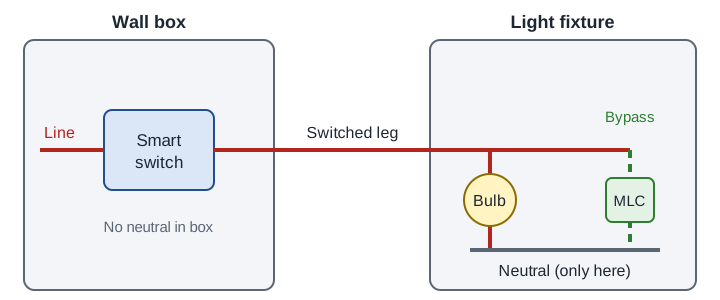
The minimum load is the smallest load the switch can borrow that current through and still stay powered. LED bulbs are where it goes wrong: Lutron's own sheet allows that some loads "may still flicker or glow in the off state" even with its bypass fitted. That is why the published minimums come in two different forms: a wattage for incandescent and halogen, and either a bulb count, a wattage or an accessory requirement for LED.
The minimum loads, model by model#
As each maker publishes them, read in October 2026. These are no-neutral models only. "None published" means the documents read give no minimum, not that any load is approved.
| Model | Type | Minimum LED load | Minimum incandescent / halogen | Maximum LED | Also required |
|---|---|---|---|---|---|
| Lutron Caseta PD-6WCL | Dimmer | 1 bulb, from Lutron's LED list | 25 W | 150 W | Nothing extra |
| Lutron Diva Smart DVRF-6L | Dimmer | 1 bulb, from Lutron's LED list | 25 W | 150 W | Nothing extra |
| Lutron Caseta PRO PD-10NXD, no neutral | Dimmer | 1 bulb, but "in some low-wattage applications" a neutral is required | 25 W (10 W with neutral) | 250 W | Neutral for LED drivers and MLV |
| Lutron Caseta PD-5WS-DV | On/off switch | "Use LUT-MLC" (included) | 25 W | 5 A | LUT-MLC at the fixture for LED |
| GE Cync no-neutral dimmers (2 models) | Dimmer | 15 W | 15 W | 150 W | Ground wire; bulb adapter under 15 W |
| GE Cync no-neutral switches (3 models) | On/off switch | 15 W | 15 W | 1.25 A (150 W) | Ground wire; bulb adapter under 15 W |
| Leviton Decora Smart DN6HD | Dimmer | None published | None published | 300 W | Ground wire; MLWSB Wi-Fi bridge |
| Leviton Decora Smart DN15S | On/off switch | None published | None published | 5 A | Ground wire; MLWSB Wi-Fi bridge |
| Inovelli Blue Series VZM31-SN | Dimmer or on/off | None in the manual; 25 W on Inovelli's forum | None in the manual | 300 W | Bypass "may" be needed |
Sources: Lutron spec submittal 369987, the Cync spec sheet and wiring guide, Leviton's DN6HD and DN15S specification and instruction sheets, and Inovelli's Blue Series manual and community forum. The two Cync dimmers are CSWDMBLBWF1NN and CSWDMOCBWF1NN (one with a motion sensor); the three switches are CSWONBLBWF1NN, CSWONBLTWF1NN and CSWONBLPWF1NN.
Two models that look like they belong here do not. Inovelli's Blue Series On/Off Switch, VZM30-SN, "is not compatible in non-neutral situations," in the words of its manual. Lutron's PD-5ANS, PD-6ANS and Claro DVRF-5NS are neutral-wire switches, and only the PD-5WS-DV is Caseta's no-neutral on/off switch.
Where the 25 W rule comes from#
Two answers circulate. One says no-neutral switches need 25 W. The other says one LED bulb is enough. Both trace back to real documents, and the table shows which is right for which product.
25 W is an incandescent figure. In Lutron's spec submittal, 25 W is the minimum for incandescent and halogen on every no-neutral Caseta model: the PD-6WCL, DVRF-6L and PD-5WS-DV, and the PD-10NXD when it runs without a neutral. The same PD-10NXD drops to 10 W the moment a neutral is connected, and the neutral-wire PD-5ANS and PD-6ANS switches start at 10 W too. So the 25 W is the price of having no neutral, and it is stated for filament bulbs. The other place 25 W lives is Inovelli's community forum, where a user quotes Inovelli's guidance, "You will need to install a bypass if your total load is below 25W", and a reply calls 25 W "the published standard" while doubting it is "truly accurate". It is not in the current Blue Series manual.
One bulb is Lutron's LED figure, for its dimmers, with a condition. The PD-6WCL, DVRF-6L and PD-10NXD all list the LED minimum as "1 bulb", footnoted to Lutron's LED bulb list. One bulb that Lutron has tested is not the same claim as any one bulb.
Neither applies to Cync or Leviton. Cync states 15 W for every load type. Leviton states no minimum and markets the DN6HD and DN15S with "Off Means Off: Low-wattage LED bulbs always turn off."
So "25 W" is right for an incandescent load on a Lutron no-neutral control, and a working rule for an Inovelli Blue dimmer. It is wrong as a general LED rule, and it overstates what Lutron asks of a single listed LED bulb on its dimmers.
Add up the real watts, not the equivalent#
Every minimum here is in actual watts. An LED box sold as "100 W equivalent" is describing brightness. The power it draws is the smaller figure printed elsewhere on the box and on the bulb.
The Inovelli thread above is the worked example. The user fitted two LED bulbs sold as 100 W equivalent, each drawing an actual 14.5 W, and did the sum: 29 W, over the 25 W line. The switch still lost power, and worked again when one bulb went back to incandescent. The reply: "It's not a perfect science, particularly with LEDs." Another member reports a fixture at about 30 W of LED that ran fine until the voltage dipped when a vacuum cleaner started, and a bypass cured it.
So treat the published minimum as a floor that must be met, not as a guarantee once it is. Then compare the total:
- Under 15 W of real LED load: Cync needs its bulb adapter. Inovelli's dimmer is below its forum figure, so expect a bypass. A Lutron dimmer is fine only if the bulb is on Lutron's list. Lutron's PD-5WS-DV needs the LUT-MLC whatever the wattage.
- 15 to 25 W: Cync is satisfied. Inovelli is below its forum figure, so plan for the bypass.
- Over 25 W: every published wattage minimum is met (Lutron's PD-5WS-DV still wants its LUT-MLC), and the risk that remains is the LED-driver behavior none of the makers can rule out.
The fix: a bypass at the fixture#
Each maker supplies or sells a part that gives the trickle current a path other than the bulb. All of them go at the light, because that is where the neutral is.
- Lutron LUT-MLC. Included with the PD-5WS-DV. Lutron says it "may be required, especially at lower wattages," that it "must be installed" if the switch's status LED is flashing or solid red, and that installing it with LED, fluorescent and ELV loads "regardless of wattage is recommended". It goes "inside a load fixture or in a separate junction box within the circuit". Lutron also says that rarely, a load still flickers or glows with one fitted, and then a different load or more than one LUT-MLC is required.
- Cync bulb adapter. In the box with every Cync no-neutral switch, for medium-base sockets. The wiring guide says to use it below 15 W, and also with non-dimmable LED bulbs or with Cync or C by GE smart bulbs on the circuit, whatever the wattage. Where it will not fit, Cync sells a Fixture Adapter separately.
- Inovelli bypass. The Blue Series manual says that with no neutral, "you may need to install a special bypass to prevent flickering and/or keep your switch powered," and links Inovelli's own. The January 2026 advisory adds a second use: after firmware 3.04, some non-neutral installs behave erratically near the top of the dimming range, and a bypass or a lower Maximum Level setting fixes it.
- Aeotec Bypass. A third-party module, 25 x 10 x 19 mm, that Aeotec says may be needed for lighting that uses less than 4 watts, and that works with a range of other makers' dimmers.
The other requirements that decide it before wattage does#
The minimum load gets the attention, but three other lines in the table rule products out faster.
A ground wire. Cync's wiring guide lists "Ground wire is required" first among its requirements, and Leviton's DN6HD and DN15S instructions say "Line, Load, and Earth Ground connections are required," with a Leviton troubleshooting line saying a DN15S that stays off and unresponsive needs a Line, Load and Ground connection. If your box has no ground, Cync and Leviton are out before wattage is considered.
3-way and 4-way circuits. Cync works in a 3-way only when every switch on the circuit is a Cync switch, and not at all in a 4-way, because more switches on the circuit need more current syphoned from the load. Inovelli's manual marks a multi-way circuit with an ordinary toggle switch and no neutral as not compatible, and sends you to its Aux switch. Leviton pairs the DN6HD with its wire-free companion dimmer and switch. Lutron lists the PD-5WS-DV, PD-10NXD and DVRF-6L for use with a mechanical 3-way switch, and the PD-6WCL is missing from that list; Lutron's wiring options for it use a Pico remote for the second location. Smart switches, dimmers and the neutral wire explains the wiring options behind each approach.
A hub or bridge. Leviton's no-neutral devices need the MLWSB Wi-Fi bridge, which supports up to 25 no-neutral dimmers and switches. Cync switches talk Wi-Fi and Bluetooth directly. Caseta controls work alone and join Lutron's system through its bridge, which has its own ceiling in how many devices a hub can handle. Inovelli's Blue Series is Zigbee, so it needs a coordinator, covered in Zigbee explained.
Smart bulbs behind a no-neutral switch#
Cync is the one maker here that names smart bulbs directly: Cync or C by GE smart bulbs on the circuit mean the bulb adapter is required. A smart bulb holds its own radio, so it is a poor load for a switch that has to borrow current through it. The broader rule on this site is one smart thing per circuit. Either a smart switch with plain dimmable bulbs, or smart bulbs with a battery remote over the switch, as smart lighting that stays compatible and automation design that holds up both argue.
Where this leaves your choice#
Work the decision from the wall box out:
- Check the box for a neutral first. If you have one, buy a neutral-wire switch and this page no longer applies. The neutral wire guide shows what to look for.
- No neutral, no ground: Lutron, or Inovelli, whose documents read here state no ground requirement. Cync and Leviton say they need one.
- One or two low-wattage LED bulbs: a Lutron no-neutral dimmer with bulbs from Lutron's list, or any of the others with a bypass at the fixture.
- An on/off switch with an LED load: Lutron's PD-5WS-DV with its LUT-MLC, Cync above 15 W or with its adapter, or Leviton's DN15S if you have ground and a bridge.
- Cannot open the fixture at all: choose the switch whose minimum your existing bulbs already meet, or skip the in-wall switch for smart bulbs and a remote.
Depth is the next filter, since no-neutral switches still have to fit: smart switch box depth and fill has the numbers. The radio decides what happens when the internet drops, as what still works in an internet outage shows, and Caseta's own radio is the case made in proprietary radios: Lutron, Hue, Tuya and friends. Cync and Leviton are Wi-Fi devices, with the costs listed in the hidden costs of Wi-Fi smart devices. Run the result through the compatibility checker, and put the neutral, ground and wattage checks on your pre-purchase checklist. Renters should read a smart home for renters first, since a switch swap is a change to the unit.
Where this page stops#
- Brands read: Lutron Caseta and Diva, GE Cync, Leviton Decora Smart and Inovelli Blue Series, from their own specification sheets, manuals and help pages as of October 2026. Enbrighten, Aqara and Treatlife no-neutral products were not read from first-party documents, so the page makes no claim about them.
- Lutron's figures are from spec submittal 369987 dated 24 February 2023. Lutron revises its submittals; the one for your exact part number wins.
- Inovelli's 25 W is a forum figure, quoted from earlier Inovelli guidance. The current manual gives no number.
- No maker here publishes the standby current its switch draws, so this page does not convert any of the minimums into milliamps.
- US, 120 V. Lutron's PD-5WS-DV is also rated at 277 V for commercial circuits, which this page does not cover.
What is the minimum wattage for a no-neutral smart switch?
It depends on the model. Lutron's no-neutral Caseta and Diva dimmers need one LED bulb from Lutron's list, or 25 W of incandescent. GE Cync's no-neutral switches need 15 W. Inovelli's forum gives 25 W for its Blue Series dimmer. Leviton's DN6HD and DN15S publish no minimum.
Why do my LED bulbs glow or flicker when the no-neutral switch is off?
The switch keeps itself powered by passing a small current through the bulb, and an LED's driver can respond to that current by glowing or flickering. The fix is a bypass wired across the light at the fixture, such as Lutron's LUT-MLC, so the current flows through it instead of the bulb.
Is the 25 watt minimum for real watts or equivalent watts?
Real watts. Every published minimum is the power the bulbs actually draw, printed on the bulb and box, not the "60 W equivalent" brightness figure. Even meeting it is not a guarantee with LEDs: Inovelli's forum has a case of 29 W of LED that still needed a bypass.
Does a Lutron Caseta no-neutral switch work with one LED bulb?
The PD-6WCL and Diva DVRF-6L dimmers list one LED bulb as the minimum, from Lutron's tested bulb list. The PD-5WS-DV on/off switch is different: Lutron says to use the included LUT-MLC with LED loads, and recommends fitting it regardless of wattage.
Do no-neutral smart switches need a ground wire?
Some do. GE Cync and Leviton's no-neutral Decora Smart devices require a ground connection in their installation documents. The Lutron and Inovelli documents read for this page list no such requirement.
Can I use a no-neutral smart switch in a 3-way circuit?
Usually, with conditions. Cync allows a 3-way only if every switch is Cync, and no 4-way. Inovelli needs its Aux switch rather than a toggle. Leviton uses wire-free companions. Lutron's PD-5WS-DV, PD-10NXD and DVRF-6L work with a mechanical 3-way switch; the PD-6WCL uses a Pico remote.
Primary sources
Specification and vendor documentation we checked while writing this page. Where a claim depends on firmware behaviour rather than a published spec, the page says so inline.
- Lutron, Caseta load controls specification submittal 369987 (rev. 2.24.23)
- GE Lighting, Cync No Neutral Required Switches specifications
- GE Lighting, Cync 3-Wire (No Neutral Required) Switch Compatibility and Wiring Configurations Guide
- Leviton, Decora Smart No-Neutral Dimmer DN6HD product specification (Jan 2022)
- Leviton, DN6HD instruction sheet
- Leviton, Decora Smart No-Neutral Switch DN15S product specification (Jan 2022)
- Leviton, DN15S instruction sheet
- Inovelli, Blue Series Dimmer Switch manual (VZM31-SN)
- Inovelli, Blue Series On/Off Switch manual (VZM30-SN)
- Inovelli, VZM31-SN firmware 3.0+ advisory for non-neutral installations (January 2026)
- Inovelli Community, wattage minimums for non-neutral installation without bypass
- Aeotec, Bypass