How many Christmas light strings can you plug into an outdoor smart plug?
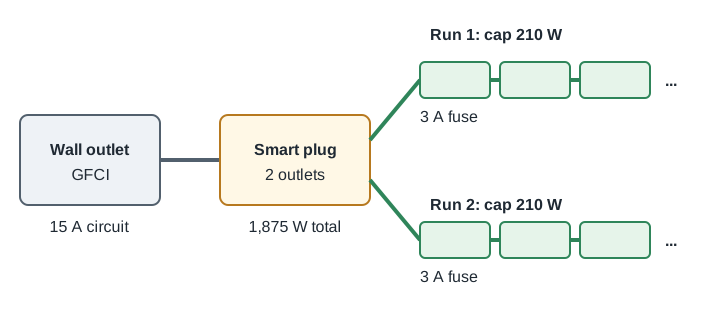
As many as the strings allow, which is far fewer than the plug allows. The 1,875 W on the plug is a total for the plug. Each run of strings stops at the cap printed on its own cord tag, 210 W on 22 AWG wire, and the plug does not raise it.
Two answers circulate, and only one is about the strings#
The first answer reads the plug. An outdoor smart plug such as the Kasa EP40A is rated "15A, 1875W", an LED mini set draws 4 to 7 W, and 1,875 divided by 7.2 is 260. So, the reasoning goes, you can hang hundreds of LED strings off one plug.
The second answer reads the box the lights came in, which says something like "connect up to 29 sets" or "not to exceed 210 watts".
The second governs, because the two numbers belong to different wires. The plug's 1,875 W is the most the plug may carry, in total. The 210 W is what the thin wire in a light string may carry, and in a chain of strings plugged end to end, every set's current passes through the first set's wire. A bigger plug upstream does nothing for that wire; the only protection sized for it is the fuse in the first string's plug.
So the plug's number tells you how many separate runs you can feed, and the string's number how long each run can be. "Hundreds of strings" is only true as several runs of a few dozen, each starting at the plug.
Where the 210 W comes from#
Christmas Lights, Etc. summarizes the history. The old rule was that "only three strings could be linked together." In February 2008 UL 588, the standard for seasonal and holiday decorative products, was revised for lower wattage lights: on 22 gauge wire, any number of strings can be linked "so long as the wattage does not exceed 210", and on 20 gauge wire up to 420. That is 1.75 A and 3.5 A at 120 V.
You do not need to know the gauge, because the standard makes the maker print the answer. The UL 588 update notice Intertek issued in 2020 gives the required cord tag wording at clause 125.4.3: "This lighting string is rated ___ Watts (___ Amps), do not overload. Connect other lighting strings or decorative outfits end-to-end up to a maximum of ___ Watts (___ Amps) total." The total is filled in as "the conductor wattage based on 120 V times the maximum conductor current" in the standard's Table 13.1. The Colorite icicle set read for this page carries the first half of that line: "This lighting string is rated 5 Watts (0.05 Amps), do not overload."
The tag is the number to use. Christmas Central's lighting guide adds the fuse sizes behind it: incandescent mini lights and most LED sets carry a 3 A fuse in the plug, and C7, C9, G40 and G50 sets a 5 A fuse.
The strings: watts, caps and sets per run#
Ratings as each listing or document publishes them, read in October 2026. "Sets by watts" is the run cap divided by the set's watts, rounded down, counting the first set.
| String | Type | Watts per set | Wire | Cap on the listing or sheet | Sets the maker allows | Sets by watts | What limits the run |
|---|---|---|---|---|---|---|---|
| Northlight 100 LED mini, warm white | LED | 7.2 W (0.06 A) | 22 AWG | 210 W | "up to 29 sets" | 29 | Watts |
| GE 100 count blue mini, always lit | Incandescent | 48 W (0.4 A) | 22 AWG | 210 W | Not given as a count | 4 | Watts |
| 4 x 6 ft purple mini net, 150 bulbs | Incandescent | 61.2 W (0.51 A) | 22 AWG | 210 W | "up to 3 sets" | 3 | Watts |
| Northlight 25 opaque red C9 | Incandescent | 175 W (1.46 A) | 20 AWG | 210 W on the listing | Not given | 1 | Watts: a second set makes 350 W |
| Colorite 100 LED 7 mm icicle, CLEDD-L7-100 | LED | 5 W (0.05 A) | Not stated | Not stated | Seven sets on one plug and control box | 42 at 210 W | The printed set count |
| Satco S11196 16 ft rope string, S14 lamps | LED | 4 W | Not stated | Not stated | "Connectable Units 3" | 52 at 210 W | The printed set count |
Three things in that table matter more than the arithmetic:
- The watts math checks out against the listings. 29 Northlight LED sets come to 208.8 W, just under 210 W, and the listing says 29. Three net sets come to 183.6 W, and the listing says three. Divide the cap by the set's watts and round down, and you get the maker's own count.
- A low set count can come from something other than watts. The instruction sheet Lowe's hosts for the Colorite set (printed by Nicolas Holiday, and naming GE StayBright sets in that paragraph) says that for end-to-end connections "up to seven (7) sets, you will need only one (1) plug and one (1) control box" and that "you may only add six (6) additional sets to your master set for a total of seven (7) connected sets." Seven sets is 35 W. The limit is the control box, not the wire, and no smart plug changes it. Satco's rope string stops at three units, 12 W.
- The C9 row is where 210 and 420 diverge. The Northlight C9 set is 20 AWG wire, the gauge UL 588 allows 420 W on, but its listing says "not to exceed 210 watts". On 210 W, one set is the run. On 420 W, two sets (350 W) fit. When a listing and the gauge disagree, the tag on the string in your hand decides, and if you cannot find one, use the lower number.
The plugs: what the rating covers#
Outdoor smart plugs read for this page, as published by each maker in October 2026. The 80% column applies TP-Link's FAQ 2650, which says "the load should not exceed 80% of the rated maximum capacity", and works at 120 V. It is the same line the space heater page draws for a 1,500 W heater, and a display that runs every evening for six weeks is as steady a load.
| Plug | Rating its maker publishes | Shared or per outlet | 80% at 120 V | Full 210 W runs at 80% | Weather rating | Operating range |
|---|---|---|---|---|---|---|
| TP-Link Kasa EP40A | 15 A, 1875 W, 1/2 HP motor | "15A maximum load in total" (EP40 datasheet) | 12 A, 1,440 W | 6 | IP64 | -4°F to 122°F |
| Wyze Plug Outdoor | "15A Max with Overload Protection", 1/2 HP motor | Not stated; two independently controlled outlets | 12 A, 1,440 W | 6 | IP64 | -4°F to 120°F |
| Leviton D215O, LED load | "5A LED/CFL/Electronic Ballast" | Not stated | 4 A, 480 W | 2 | IP65 | -20°F to 122°F |
| Leviton D215O, incandescent load | "1500W Incandescent/Halogen" | Not stated | 1,200 W | 5 | IP65 | -20°F to 122°F |
The 1,875 W figure is 15 A at 125 V, the voltage TP-Link rates the EP40A at. A US outlet is nominally 120 V, where the same 15 A is 1,800 W, so do the sums at 1,800 and 1,440.
Set the two tables side by side:
- A two-outlet plug with one run per outlet, which is how most people use one, is limited by the strings, not the plug. Two runs of 29 Northlight LED sets are 58 sets and 417.6 W, 22% of the EP40A's 1,875 W. Two runs of four GE incandescent sets are eight sets and 384 W.
- "Shared" means both outlets together. TP-Link's datasheet says 15 A "in total", so the EP40A's two outlets are not 15 A each. Wyze does not say either way, so treat its 15 A as the total for the plug too.
- Leviton's LED rating is the one for LED strings. The D215O carries 15 A for general use, but its LED figure is 5 A, a third of that. Leviton names "string lights and holiday lights" among its uses, and on LED strings the 5 A is the line to stay under.
- Inflatables are motors. Wyze names "festive holiday inflatables", which run on a blower. A 1/2 HP rating is what covers them, not the 15 A, as it is for a window air conditioner; the dehumidifier page has the conversion from horsepower to amps.
How to work out your own display#
Read the cord tag on the first string of each run
Note the set's watts and the "end-to-end up to a maximum of" figure. If the tag gives only amps, multiply by 120.
Count sets per run
Divide the run cap by the set's watts and round down. If the box prints a lower set count, use that.
Add up the runs
Multiply each run's actual watts, not its cap, and add them. Mixed runs are fine: a run's cap belongs to its first string, and every set in that run must be within it.
Check the plug total
Keep the sum under 80% of the plug at 120 V: 1,440 W for a 15 A plug, 480 W of LED for the Leviton D215O.
Check the circuit
The plug shares its breaker with everything else on that circuit. A garage freezer or a block heater on the same 15 A outdoor circuit comes out of the same 1,800 W.
A worked case: a roofline of 20 Northlight LED sets (144 W) on one outlet, and a tree wrapped in four GE incandescent sets (192 W) on the other. Both runs are within 210 W, the plug carries 336 W, 18% of 1,875 W, and the circuit has room. Add a fifth GE set to the tree and the plug still has room, but that run is at 240 W, over its tag. Start a new run instead.
IP64 is about the plug, GFCI is about you#
IP64 is the plug's housing. TP-Link's datasheet explains its rating as protection "from dust and splashes of water from any direction". It is not a rating for a plug lying in a puddle, and TP-Link adds that "when not in use, the sockets should remain capped with the included weather-resistant cover." Leviton's IP65 is one step up on water, and it lists "rain, sprinklers, hoses, snow". Neither plug's page mentions ground fault protection, so neither is one.
GFCI is the outlet's job. The Colorite instructions say that "when products are used in outdoor applications, connect the product to a Ground Fault Circuit Interrupting (GFCI) outlet. If one is not provided, contact a qualified electrician." The CPSC says outdoor lights and decorations "should be plugged into circuits protected by ground-fault circuit interrupters (GFCIs) to protect against electric shock." A smart plug between the GFCI outlet and the lights does not change that requirement, and it is not a substitute for it, as smart plugs and what they are good at says for every outdoor plug.
How each maker says to mount the plug:
- Wyze: sockets "pointing downwards to the ground", at least 6 inches above the ground, and "plugged directly into your power outlet", not into an extension cord, which Wyze says could damage the plug and void the warranty.
- TP-Link: unused sockets capped. The EP40 ships with a clamp and screw.
- Leviton: into the outlet, or mounted beside it using the rear mounting holes.
- The strings: Satco rates the S11196 IP44 and "Damp" location, and its operating range starts at +14°F, warmer than any of the three plugs. In a northern January, the string can be the part outside its rating.
Between plug and strings, the CPSC says that "if using an extension cord, make sure it is rated for the intended use", and the Colorite sheet says not to use seasonal products outdoors "unless marked suitable for indoor and outdoor use."
What the plug adds, and what it cannot do#
A smart plug's job here is the schedule, and it is good at it. TP-Link says you can name and schedule each EP40 outlet separately, and Wyze gives its two outlets separate controls, so the roofline and the tree can switch at different times. The Colorite sheet asks you to "unplug when leaving the house, when retiring for the night, or if left unattended", and a plug that turns the display off at 11 p.m. does that for you.
What it cannot do:
- It cannot protect a run. Overload protection, where a plug has it (Wyze lists it), acts on the current through the whole plug. A single run at 300 W on a 15 A plug is nowhere near tripping it, and the only protection that run has is the 3 A fuse in the first string's plug.
- It cannot make the strings dimmable. Satco lists the S11196 as "Non-Dimmable", and a plug that only switches on and off is the right control for it. Dimming holiday lights is a smart lighting question, not a plug one.
- It may not come back on by itself. After a power cut, a plug restores its outlets according to its own power-on setting, which apps often hide. Test it once by unplugging the plug and plugging it back in, and see what still works when the internet goes down for why schedules can stop when the cloud does.
Range is the other common failure. Wyze quotes "up to 300' WiFi range" in open space, and a plug on the far side of a brick wall in December gets much less. If the yard is beyond your Wi-Fi, a Z-Wave outdoor plug on a local hub such as Home Assistant holds a schedule with the internet down, for the reasons in local versus cloud control. An automation that turns the lights on at sunset and off at a fixed time is the kind that survives a season; automation design covers why.
Where this page stops#
- Plugs read: TP-Link Kasa EP40A and its EP40 datasheet, Wyze Plug Outdoor, Leviton D215O. Kasa's EP40 product page returned an error and Meross's outdoor plug specifications were not found on a first-party page, so the page states nothing about either. Other plugs may rate each outlet separately; check the model's own sheet, as the buying checklist says for any device.
- Strings read: six, from retailer listings, one instruction sheet and one spec sheet. GE and Home Accents instruction sheets with their own set counts were not read, so the page does not quote them.
- The 210 W and 420 W figures are from a lighting retailer's summary of UL 588. The standard itself was not read; the tag wording comes from Intertek's update notice. The tag on your string outranks both.
- US, 120 V, plug-in seasonal lights. Permanent eave lighting wired to a transformer, and 12 V landscape lighting, are not end-to-end strings and are outside this page. Hardwired outdoor lighting belongs on a smart switch.
- Matter does not change any of this. A Matter on/off plug-in unit is the same relay with the same rating, whatever controller drives it.
How many Christmas light strings can I plug into an outdoor smart plug?
One run per outlet, each as long as the first string's tag allows: 210 W total on 22 AWG sets. That is 29 of a 7.2 W LED mini set or 4 of a 48 W incandescent set per run. A two-outlet plug such as the Kasa EP40A shares its 1,875 W across both outlets, so two full runs use about 22% of it.
Does a 15 amp smart plug let me connect more strings end to end?
No. The end-to-end limit belongs to the wire inside the first string, which carries every set connected after it. UL 588 sets it at 210 W for 22 AWG and 420 W for 20 AWG, and the maker prints it on the cord tag. The plug's rating only limits the total of all runs it feeds.
Is the 15 A on a two-outlet outdoor plug per outlet?
Not on the Kasa EP40, whose datasheet says "15A maximum load in total". Wyze gives "15A Max" without saying, so treat it as the total. Keep the combined load under 80% at 120 V, 1,440 W, which TP-Link's plug FAQ asks for.
How many LED light strings can be connected together?
Divide the end-to-end cap on the tag by the set's watts and round down. A 7.2 W, 100 LED Northlight set on a 210 W cap gives 29, which is what its listing says. Some LED sets stop much earlier for other reasons: one Colorite icicle set allows seven, set by its control box, and a Satco rope string three.
Is an IP64 smart plug safe in the rain without a GFCI?
No. IP64 means the plug is protected from dust and splashing water from any direction. It does not protect people from shock. Light makers and the CPSC say outdoor lights belong on a GFCI-protected outlet, and none of the plug documents read here claims ground fault protection.
Primary sources
Specification and vendor documentation we checked while writing this page. Where a claim depends on firmware behaviour rather than a published spec, the page says so inline.
- TP-Link, Kasa Smart Wi-Fi Outdoor Plug EP40A specifications
- TP-Link, Kasa Smart Wi-Fi Outdoor Plug EP40 (US) 1.0 datasheet (April 2021)
- TP-Link, what should I do if my smart plug feels warm (FAQ 2650)
- Wyze, Wyze Plug Outdoor product page and specifications
- Leviton, Decora Smart Wi-Fi Outdoor Plug-In D215O
- Intertek, UL 588 Standards Update Notice (revision of 27 November 2018, effective 27 November 2020)
- Christmas Lights, Etc., UL standards for Christmas light strings
- Christmas Central, watts matter: how many lights can you safely string together
- Christmas Central, Northlight set of 100 warm white LED mini lights
- Christmas Central, GE 100 count blue mini always lit light set
- Christmas Central, 4 x 6 ft purple mini net style lights
- Christmas Central, Northlight set of 25 opaque red C9 lights, 20 AWG
- Colorite, LED 100L Color Choice 7 mm icicle light set CLEDD-L7-100 instructions (Lowe's copy)
- Satco, S11196 16 ft LED natural rope string light spec sheet
- CPSC, holiday season decorating safety tips (2005)